I’m seeing a lot of pomp and show around AI and LLM these days. The quality of instant translation is a widely discussed topic, and there are many supporters advocating AI over human workflows, insisting that “AI has evolved” or because, from the leadership point of view, “AI is reasonably priced”. In their defence, they see that well-prompted or well-trained machines have presented a polished structure to the output, and it gives a positive first impression.
But, thanks to my experience as a translator or localisation lead, and after working with multiple organisations, I am not on the “AI only” side. I had the opportunity to witness a few phases of raw MT[1], LLM[2], NMT[3], AI[4], and programs like Copilot[5], ChatGPT[6], DeepL[7], Amazon Translate[8], Google Translate[9], and more! This allowed me to gain firsthand experience of reality.
Although these phases were certainly brief, but valuable enough to get a gist of what they’re offering. This was particularly the real side of Expectation vs. Reality scrutiny! These experiences allowed me to understand the basic structure of these engines. And with my experience as an executive managing multi-million word projects and jobs involving 20+ languages, I can see the common pattern somewhat clearly from a different side of the table.
Ideal AI vs. Ideal Linguist :
(Considering only expected variables.)
After seeing translation engines in action, I can say that they work based on the mathematical formula of certainty. In correct terms, it is “Rule-based” or “Statistical” translation.[10] Since strategy and structure can be compiled into a potentially never-changing document, these engines put strategy and structure first. Then they attempt to implement the context. And the thing with context is that it is very fluid.
A human translator understands context based on his/her expertise or experience as a native or near-native speaker of the target language. But since calculations can’t have those references sketched out, engines simply use the best probability analysis approach to translation.
So, as a result of this practice, the most common thing with non-human translation is a lack of fidelity with the source and uneven distribution of context in translation, if any. If you look at the content without comparing it with the source, it will look good-enough, most of the time. But whether it is good enough or not, that’s a different discussion.
The good, the bad, and the ugly side of AI :
I would say that AI can be considered a sophisticated approach which provides almost consistent results based on the complexity of the content; sometimes the results are excellent, sometimes good enough, and oftentimes, just bad. The only point being that this is due to the fact that AI strategy is completely opposite to how a human would think or translate.
I will also mention that most of the well-trained engines are better trained for the English language, but with other non-standard languages, the results are usually more problematic. I have seen more concerns about quality and consistency when customers receive translations from English into other languages. While the results from other languages to English seem a bit better.

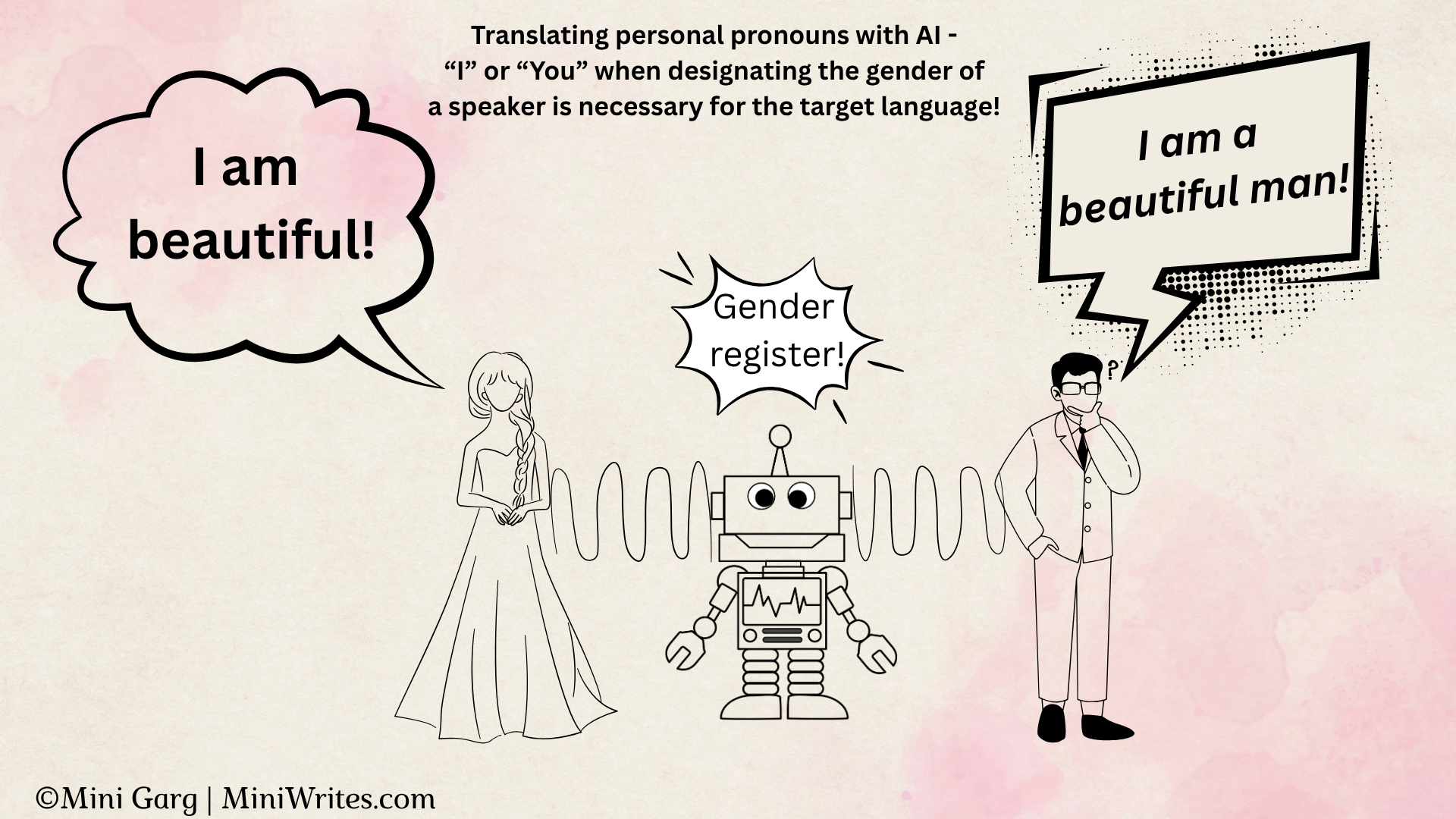
Here’s an English to Hindi example that will illustrate this issue to some extent :
If a machine translates any sentence with personal pronouns like “I” or “you”, the first major inconsistency and challenge will be designating the gender of a speaker. Because Hindi has this rule to clarify the grammatical gender register of a speaker. But in this scenario, English strips away this information and generalises the gender register in its structure. Machines will not ask you which gender you want to put in place of these personal pronouns, because that defeats the purpose of instant translation. Instead, most machine engines have “masculine” gender prioritised, so most of the translations will, by default, pick up male gender, unless specifically advised otherwise with the help of prompt engineering. Despite that, there are always chances that the engine creates inconsistencies in tone of voice or gender.
I have seen people pushing for AI or instant translations, but going for human review to ensure accuracy is present in the output. I would ask the reason, but why bother when I have seen the answer practically? The reason is that when you take AI translation, from the leadership or user’s perspective, you don’t have anyone to take ownership of that content, including all the errors it may have. “AI responsibility” is not something you can count on. If any mistranslation causes legal or reputational harm, there’s no one to blame.

Translation engines are evolving, learning, and trying to improve with the help of experts who are putting great effort towards perfection. While removing or filtering hallucinations in instant translation or adapting to the best automated quality control metrics can be part of “Responsible AI” approach, they are not filling the gap of uncertainty that AI may make a mistake. And when it does make a mistake, and when you are on the receiving end, liability for damages will fall on the deployer, publisher, or business, and none of them actually translated the content in the first place.
There can be legal claims of product liability, negligent misrepresentation, or a consumer protection claim against the company using it, but most of the engines have “use at your own risk” written in their Terms of Services (ToS), Terms of Use or Terms and Conditions. With this policy, they are hardly touched in such scenarios. So when you look at the big picture, and from a business point of view, a service or product without ownership is not ideal. And that’s what and where AI is at the moment.
Ideal Executive Approach to AI :

Many of the clients, companies, or users are at least “trying AI,” and I’ll say they are not wrong in doing so. The AI vendor’s proposed reward almost falls into the “too big to fail” category! But in the backend, to some degree, these are usually some empty promises or claims with multi-layered problems waiting to be discovered or resolved.
The important part is implementing the precautions, understanding what AI translation can offer, analysing how you wish to safely use it, and then managing the human vs. AI workflow responsibly. This is the only way to adapt to the new wave of AI and gain excellent outcomes while also keeping track of your “expectations vs. reality” metrics.
The ideal approach, as discussed by many, is to use 25-30% automation and 75-70% human expertise at the organisational level translation to achieve the best harmony on all grounds.[11]
Conclusion :
This conversation is not new, and I can go on with more details, but the objective stays the same. This will be over-discussed in the future, but my take on this is very simple. Technology has its place; humans have their side, which is not exchangeable.
Note from Author (Mini Garg): I’ve written this piece after several years of break from research writing as I was focusing more on creative writing. And seeing the current trend of AI in creative field, I believe it is important to share that this is a piece of research and represents my thoughts, and is “Written with experience, not with AI” 😊
Thanks for reading! ⭐
Written on Monday, 22 June, 2026.
Bibliography:
[1] – Machine Translation
[2] – Large Language Models
[3] – Neural Machine Translation
[4] – Artificial Intelligence translation
[5] – Copilot – context-aware AI translator by Microsoft. AI-powered assistant built on top of Large Language Models (like OpenAI’s GPT.
[6] – ChatGPT – context-aware translations across multiple languages. AI application / agent built on top of an LLM.
[7] – DeepL – Text Translation using a custom-built Large Language Model.
[8] – Amazon Translate – Neural Machine Translation by Amazon that generates text like conversational AI.
[9] – Google Translate – Text translation by Google primarily built on Neural Machine Translation (NMT) technology. Now also offers Translation LLM (Large Language Model).
[10] Wikipedia contributors. (2026, June 1). Machine translation. In Wikipedia, The Free Encyclopedia. Retrieved 12:27, June 18, 2026, from https://en.wikipedia.org/w/index.php?title=Machine_translation&oldid=1357276502
[11] Claude Piron, Le défi des langues (The Language Challenge), Paris, L’Harmattan, 1994.